Thomas: a Bible character study on doubt and faith (John 11, 14 and 20)
Thomas is remembered for one week of his life. “Doubting Thomas” has become a phrase for anyone who will not believe without proof. But John’s Gospel lets Thomas speak three times, and together they show a braver, more honest disciple than the nickname suggests. This study takes each in turn; it works for a small group or a sermon series, and pairs with our skit Unless I See.
Who Thomas was
Thomas is one of the twelve in every list of the apostles (Matthew 10:3, Mark 3:18, Luke 6:15, Acts 1:13). John three times adds that he was “called Didymus”, which means “twin”; we never meet the twin. Everything else we know about him comes from John.
John 11: “Let us also go”
When Lazarus is dying, Jesus decides to go back to Judea, where people had just tried to stone him. The disciples protest. Thomas speaks first:
Then said Thomas, which is called Didymus, unto his fellowdisciples, Let us also go, that we may die with him.John 11:16 (KJV)
It is not a cheerful line, but it is a loyal one. Thomas expects the worst and goes anyway. A realist can also be brave.
John 14: “How can we know the way?”
At the Last Supper Jesus tells his friends he is going to prepare a place for them, “and whither I go ye know, and the way ye know.” Thomas is the one who admits he doesn’t:
Thomas saith unto him, Lord, we know not whither thou goest; and how can we know the way? Jesus saith unto him, I am the way, the truth, and the life: no man cometh unto the Father, but by me.John 14:5-6 (KJV)
One of the best-loved sentences in the Bible is Jesus’ answer to an honest question. Thomas’s question gave the rest of us “I am the way”.
John 20: “Unless I see”
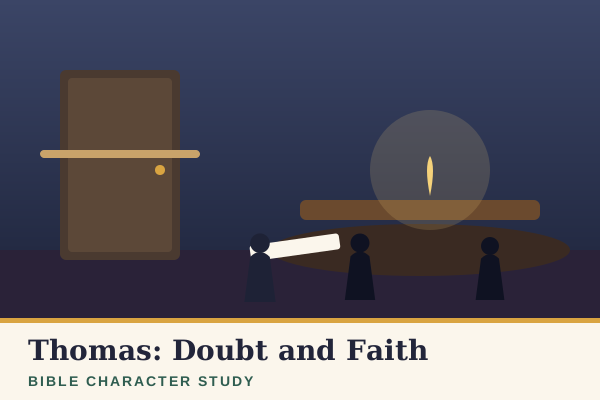
Thomas is not with the others on Easter evening. When they tell him, he answers:
Except I shall see in his hands the print of the nails, and put my finger into the print of the nails, and thrust my hand into his side, I will not believe.John 20:25 (KJV)
A week later Jesus comes again, and speaks to Thomas first, offering exactly what he asked for. John does not say Thomas touched him. He records Thomas’s answer, the fullest confession of faith in the Gospel:
And Thomas answered and said unto him, My Lord and my God.John 20:28 (KJV)
Jesus saith unto him, Thomas, because thou hast seen me, thou hast believed: blessed are they that have not seen, and yet have believed.John 20:29 (KJV)
What “doubting Thomas” gets wrong
- He asked for what the others already had. The ten saw the hands and side (John 20:20) before they believed. Thomas asked for the same.
- Jesus did not scold him away. He came back for him, by name, and met him where he was.
- His doubt ended in worship. No one else in John calls Jesus “my God” so directly.
- The blessing is for us. Verse 29 reaches past Thomas to every reader who has not seen.
Questions for a group
- Thomas says three things in John. Which one sounds most like you?
- Why do you think Thomas was not with the others on the first evening?
- Is honest doubt different from refusing to believe? How?
- Jesus gives Thomas what he asks for. What does that tell us about how Jesus treats our questions?
- Read John 20:30-31. Why does John say he wrote his Gospel?
Pray: Lord Jesus, you came back for Thomas. Meet us in our questions, and bring us to say with him, my Lord and my God. Amen.