How to put on a church skit: a complete guide for small churches
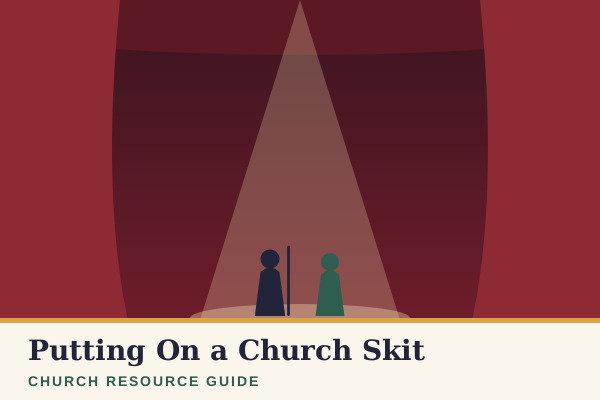
You do not need a drama team, a stage or a budget to put on a good church skit. You need a script that fits your people, three rehearsals, one person in charge and a few props from the cupboard. This guide walks through the whole thing, from choosing the script to the moment after the last line, for churches of any size.
Why a skit at all
A skit lets a congregation see a passage happen. People who drift during a reading will watch two friends argue on the road to Emmaus, and remember the line that ends it. It also gets people involved who would never preach or lead worship: the teenager who loves to make people laugh, the retired teacher with a great reading voice.
The three roles you need
The director keeps the cast on time, makes decisions and talks to the pastor. The stage manager owns the props box and the microphones on the day. The narrator carries the pace, and can rescue any missed line. In a small church one person can be director and stage manager; never make the director also the lead actor.
Choosing the script
- Length: 5-8 minutes for a Sunday service; up to 15 for a special evening.
- Cast: count the people you actually have, not the ones you hope for. Check the script’s doubling notes.
- Scripture: quoted lines should name their translation, and invented dialogue should be marked as invented.
- Fit with the service: read it aloud with your pastor. The skit should open the sermon, not compete with it.
Our Find your skit page matches scripts to your occasion, cast, ages and minutes.
Casting
Ask people one by one, and tell them exactly what you are asking: “three rehearsals, scripts in hand, about two pages of lines.” Cast the biggest comic part first; the rest falls into place around it. Give quieter volunteers parts with few lines but a clear moment. Keep a list of two people who could step in at short notice.
Rehearsals
| Rehearsal | Time | Goal |
|---|---|---|
| 1. Read-through | 30 min | Seated. Everyone hears the whole story; time it; answer questions. |
| 2. Walk-through | 45 min | On the stage with the props. Tape the floor for entrances and the “tomb” or “inn”. |
| 3. Full run | 30 min | With microphones, once or twice, then stop. |
Scripts in hand are fine for a short skit. Print each actor’s lines highlighted (our paid scripts include a highlighted-lines sheet for every actor) and put the scripts in a black folder so they look intentional.
Props, costumes and set
Less is better. One strong prop per scene does more than a full set: a cardboard stone, a round loaf of bread, a clipboard. A white sheet over a table is a tomb; the centre aisle is a road. Costumes can be scarves and plain dark clothes. Keep everything in one labelled box so nothing goes missing between rehearsals.
Sound and sightlines
If people cannot hear, nothing else matters. Use one or two handheld microphones and practise passing them, or place a single boundary microphone at the front of the stage. Teach one rule: face the congregation when you speak, even when talking to someone beside you. Walk to the back of the room during rehearsal 3 and listen.
Working with children
Give young children one short line they can say with joy, ideally together. Seat them close to the action so entrances are quick. Have a helper backstage, and follow your church’s safeguarding policy for every rehearsal. Parents will come to watch; tell them the date early.
Permissions and licences
Published scripts come with terms. Ours include performance rights for your congregation (see the licence). If you record or livestream the service, check the script’s licence covers that, and ask parents before filming children. Quoted scripture in the King James Version is free to use; other translations have their own permissions, usually generous for church use.
When it goes wrong
Someone will miss a line. The narrator can cover with a line of narration; the audience never knows. If an actor is ill on the day, the narrator reads their part from the lectern; doubling notes in the script show how. If the microphones fail, the cast steps forward and speaks up. Afterwards, thank everyone by name, publicly.
A one-page checklist
- Script chosen and read with the pastor (6 weeks out)
- Cast asked in person, with a stand-by list (5 weeks)
- Scripts and highlighted lines handed out (3 weeks)
- Three rehearsals booked, the last one with microphones
- Props box packed and labelled
- Safeguarding and parental consent in place for children
- Slot confirmed in the order of service, with a time limit
- Thank-you planned for the cast
Need a script to start with? The Stone Is Rolled Away (Easter) and Make Room (Christmas) are free.